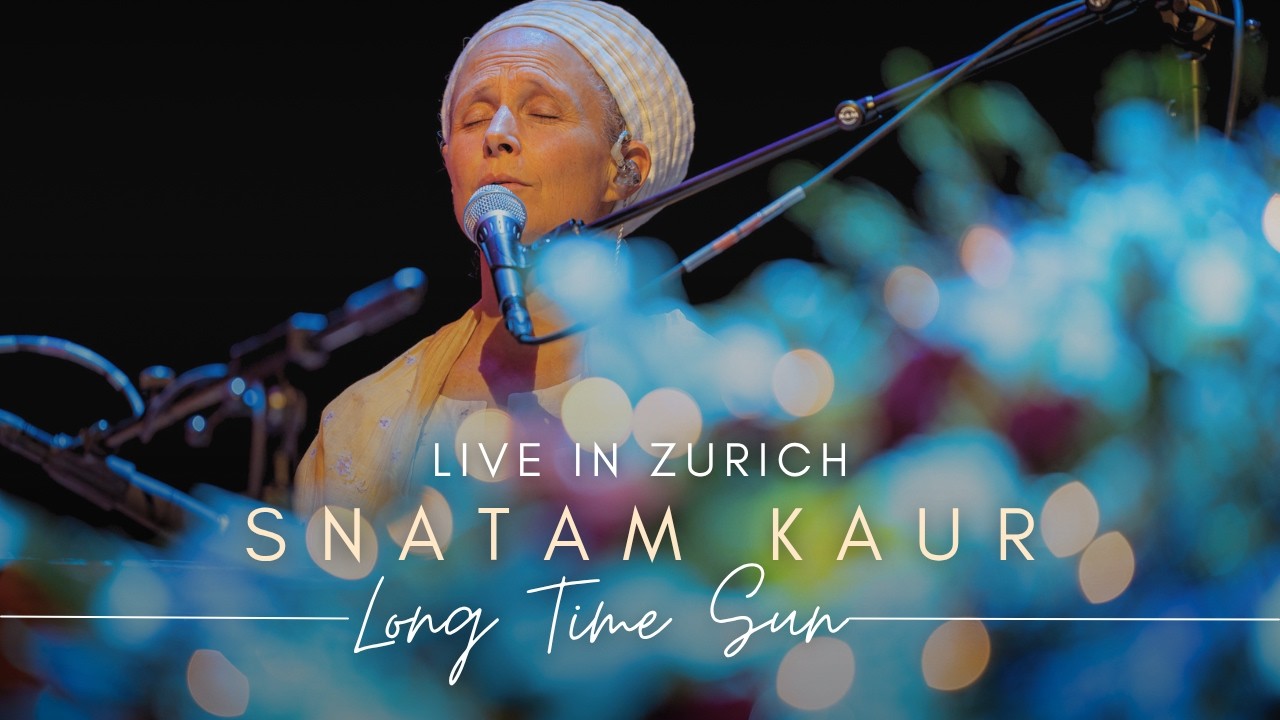
In this brief but potent conversation, Snatam Kaur and Jahnavi Harrison discuss the role of naam—the sacred name—as a healing medicine, how sound current itself carries transformative power, and what drew them to collaborate on the single Tayraa Naam. Both artists root their practice in sacred texts filled with devotional poems, which they activate through singing as part of their spiritual tradition. The conversation illuminates how two distinct lineages of sacred chant meet in a single work of art.
What Is Naam and Why Does It Heal?
At the heart of both Snatam Kaur and Jahnavi Harrison's practice lies a concept central to many South Asian spiritual traditions: naam, often understood as the sacred name of the divine. Snatam Kaur articulates this directly: "the name of the one is the most powerful medicine." This is not metaphorical language. In the framework of Kundalini yoga and Sikh spirituality (which shapes Snatam's work), naam operates as a direct technology of healing and transformation—a vibrational tool that works on the nervous system, the subtle body, and the consciousness of the practitioner.
The power of naam does not lie merely in intellectual understanding or belief. Rather, it resides in the sound current itself. When the name is sung or chanted, the frequency, rhythm, and intention of the utterance activate specific pathways in the body and mind. Snatam Kaur notes that "sound current can heal us," suggesting that the vibration itself—independent of cultural context or personal faith—carries inherent medicine. This aligns with emerging research on how sound frequency affects the nervous system, though the spiritual understanding goes deeper: the sound is understood as a direct transmission of divine energy.
How Do Sacred Texts Inform This Practice?
Both artists draw from traditions rooted in sacred poetry. Snatam Kaur describes their lineage this way: "we have a sacred text that's filled with poems." These are not ordinary poems. In Sikh tradition, the Guru Granth Sahib (the scripture that serves as the eternal Guru) contains compositions set to raag—classical Indian musical modes—designed specifically to be sung. The poems themselves are understood as the word of God, and the act of singing them (kirtan) is a form of direct communion with the divine.
The practice is explicit: "we celebrate in our spiritual practice by singing those poems." This is not performance or entertainment, though the music may be beautiful. It is a form of sadhana (disciplined spiritual practice) in which the singer and listener both participate in a transmission of sacred sound and meaning.
Jahnavi Harrison comes from a complementary but distinct lineage—the Bhakti tradition of Vaishnavism, where chanting the names of Krishna and devotional poetry form the foundation of spiritual practice. Though the lineages differ, both honor the principle that sacred texts, when sung with devotion and proper technique, become vehicles for healing and transformation.
Why Did These Two Artists Choose to Collaborate?
Snatam Kaur refers to Jahnavi Harrison as "one of my favorite Mona artists"—a signal of deep respect and artistic kinship. The collaboration on Tayraa Naam represents more than a musical partnership; it is a convergence of two living traditions that, while rooted in different historical and cultural contexts, share fundamental principles: the power of naam, the healing capacity of sound, the reverence for sacred text, and the understanding that chanting is a spiritual practice, not mere entertainment.
The choice to work together suggests a recognition that sacred sound transcends sectarian boundaries. Both artists understand that when two sincere practitioners from different lineages unite their voices and intentions around the name of the divine, the medicine becomes stronger. There is no dilution or compromise of tradition—rather, each lineage brings its full depth, and their confluence creates something new while honoring what came before.
What Does Tayraa Naam Represent?
While the transcript does not provide extensive detail about the song itself, the title "Tayraa Naam" points directly to the core teaching. In the Sikh and broader North Indian devotional context, "Tayraa" (or "Tera") means "Yours" or "Your," and "Naam" is the name of God. Thus the title itself is a prayer: "Your Name," a direct invocation and surrender to the divine. The song, then, becomes a vehicle for that invocation—a container in which two voices and two traditions sing the same essential truth: that the name of the divine is the medicine, the healer, the ultimate reality.
Where to Go from Here
Those drawn to this conversation may explore the full interview to understand more deeply how Snatam Kaur and Jahnavi Harrison each arrived at their respective traditions, what their individual practices entail, and how they approached the creative and spiritual process of bringing their voices together. Listeners interested in the healing power of sacred sound may investigate kirtan and bhakti chanting practices directly—many teachers now offer recordings and live sessions that make these traditions accessible. The underlying principle both artists affirm—that sound, when rooted in sacred intention, can heal—invites personal exploration through listening and, for those drawn to it, participation in chanting practice itself.