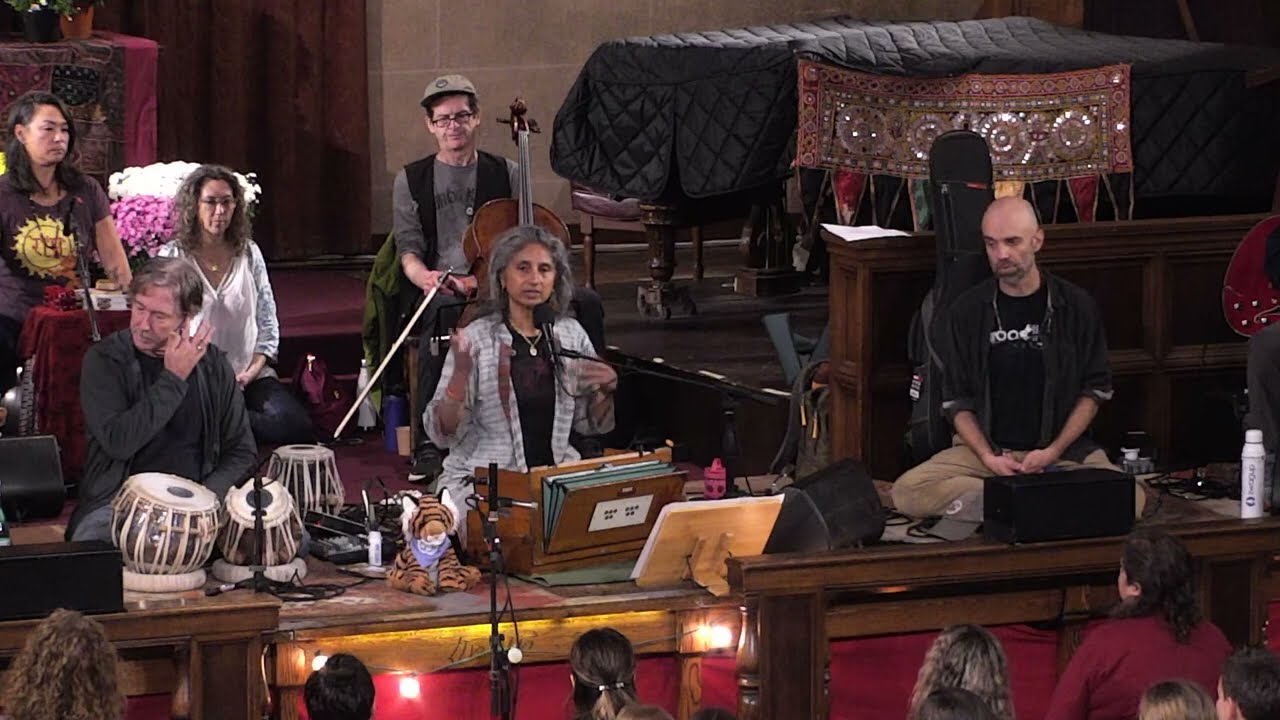
Gobinday Mukanday is a foundational Kundalini Yoga mantra that invokes eight divine names and functions—sustaining, liberating, destroying, creating—to protect the practitioner and awaken inner freedom. Snatam Kaur and Sopurkh Singh perform this sacred chant live in a weekly Mantra & Meditation class, demonstrating how repetition of these divine names purifies the mind, dissolves obstacles, and connects the chanter to the infinite intelligence that governs existence.
What is Gobinday Mukanday?
Gobinday Mukanday is a Kundalini Yoga mantra composed of eight divine names, each representing a specific cosmic function. The mantra appears in the Adi Shakti Mantra and is central to the practice of mantra meditation in the Kundalini Yoga tradition. Each word carries a specific vibrational frequency intended to invoke protection, liberation, and alignment with divine intelligence.
The eight names are:
- Gobinday — sustaining (nourishing all existence)
- Mukanday — liberating (freeing from bondage)
- Udaaray — uplifting (raising consciousness)
- Aparay — infinite (beyond limitation)
- Hariang — removing (dissolving ego and attachment)
- Kariang — creating (bringing forth new potential)
- Nirnaray — judging (witnessing with discernment)
- Akaaray — timeless (existing beyond time and space)
Together, these eight functions represent the complete spectrum of divine action—the full cycle of manifestation, maintenance, and dissolution that governs both the cosmos and the inner world of the meditator.
How Does Chanting This Mantra Work?
In Kundalini Yoga, mantra is not merely a spiritual belief system but a vibrational technology. When the tongue strikes specific points on the palate during chanting, it stimulates the vagus nerve and sends signals to the hypothalamus and pituitary gland—the master glands of the nervous and endocrine systems. This physical mechanism, combined with the psychological effect of focused repetition, creates a tangible shift in consciousness.
Gobinday Mukanday works through several layers of practice. First, the practitioner attunes to the meaning of each divine name, consciously invoking those qualities—sustenance, liberation, uplift—within their own being. Second, the vibration of the mantra itself, independent of intellectual understanding, recalibrates the nervous system and dissolves mental patterns. Third, repeated chanting over time creates a grooved pathway in the mind, gradually replacing anxiety and contracted thinking with states of trust and openness.
When chanted in a group, as Snatam Kaur and Sopurkh Singh do in their live class, the effect amplifies. Collective sound creates a coherence field that supports individual practitioners in deepening their experience. The rhythm and melody become vehicles for moving energy through the body and elevating the mind beyond ordinary thought.
The Role of Kirtan in Spiritual Practice
Kirtan—call-and-response chanting of sacred mantras—has been a core practice in Indian devotional traditions for centuries. Unlike silent meditation, kirtan engages the voice, the breath, and the emotional heart. For many practitioners, especially those new to meditation, kirtan provides an accessible entry point into contemplative states because the participatory, musical nature of the practice naturally calms the mind.
In the context of a live session like Snatam Kaur's weekly Mantra & Meditation class, kirtan serves multiple functions. It builds community among practitioners, creates a shared sacred space, and allows individuals to experience the mantra at their own depth level. Some may focus on the sound and rhythm; others may engage with the meaning of the words; still others may allow the vibration to work directly on their energy body without conscious effort.
The presence of an experienced teacher like Snatam Kaur—and a skilled musician like Sopurkh Singh—further anchors the practice. Their steady, clear rendition of the mantra provides a model for how the sounds should be pronounced and paced, and their devotional intention creates a field that supports the group's journey into deeper states.
Why Chant Gobinday Mukanday Specifically?
This mantra is considered a foundational protection mantra in Kundalini Yoga. By invoking all eight divine functions—sustaining, liberating, uplifting, infinite presence, removing obstacles, creating, judging, and timelessness—the chanter essentially enlists the intelligence of the cosmos to work on their behalf. The mantra dissolves the sense of separation between the individual self and the infinite, replacing fear and contraction with trust and expansion.
Practitioners often turn to Gobinday Mukanday during times of difficulty, uncertainty, or when feeling blocked or trapped. The mantra's invocation of liberation (Mukanday) directly addresses the experience of bondage, while its nourishment of sustenance (Gobinday) provides reassurance that one's needs will be met. The mantra does not promise escape from difficulty, but rather a shift in perspective—from feeling like a victim of circumstance to recognizing oneself as part of an intelligent, benevolent universe.
The Practice of Mantra & Meditation Classes
Snatam Kaur's weekly Mantra & Meditation class on kirtanandkundalini.com represents a modern adaptation of traditional teaching. Rather than requiring attendance at ashrams or temples, the online platform makes this ancient practice accessible to practitioners worldwide. The structure—pairing live kirtan (Gobinday Mukanday) with meditation—allows participants to activate their nervous system through chanting and then settle into receptivity through silent practice.
The live format also preserves something essential: the transmission of presence from teacher to student. While recorded classes have value, a live session carries the energetic intention and embodied knowledge of the teacher in real time. Sopurkh Singh's instrumental accompaniment—likely on the harmonium, a traditional Kundalini Yoga instrument—adds another dimension, as the harmonium's frequencies are tuned to support the opening and balancing of the chakras.
Where to Go from Here
If you're drawn to Gobinday Mukanday, consider exploring Snatam Kaur's ongoing classes at kirtanandkundalini.com or beginning your own daily practice with a recording of this mantra. Even five to ten minutes of chanting daily can create a noticeable shift in your mental state and sense of protection. You might also explore other foundational mantras in the Kundalini Yoga tradition, such as Sat Nam or the Adi Shakti Mantra (which contains Gobinday Mukanday), to deepen your understanding of how specific sounds work to align consciousness.
For those interested in the scientific basis of mantra practice, research on vagal stimulation, neuroendocrine effects, and the power of rhythmic sound offers secular validation of what yogis have known for millennia. Whether you approach the mantra through devotion, science, or both, the consistent practice of Gobinday Mukanday invites a direct experience of the eight divine functions already at work within you.