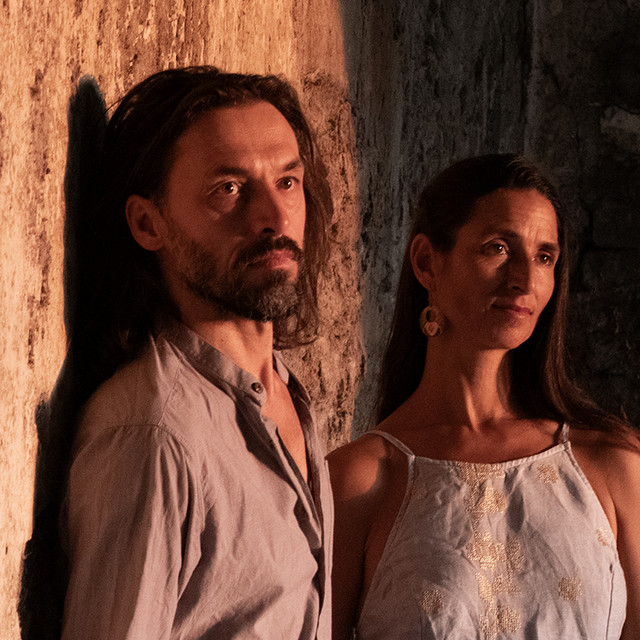
"Lady of the Well" is a musical elegy created by Angelika Baumbach and Carrie Tree as a memorial to their friend Saskia, who died and whose spirit is honored through song. The composition uses water and wind as metaphors for transformation and the continuation of connection beyond death. Rather than dwelling in sorrow, the song moves listeners through grief toward radiance and remembrance. Filmed in Lithuania and Mexico with a cinematic music video directed by Gabriel Zapata, the piece demonstrates how grief, when channeled through music and community, becomes a living bridge between worlds.
How can grief become a vessel for connection and renewal?
The song begins with an image of attempted containment: "I tried to be a vessel to contain your waters, but you kept them moving" (0:46–0:57). This opening establishes the core tension at the heart of the piece—the impossibility of holding onto someone who has died. Water, which cannot be contained, becomes the primary metaphor for the departed friend's essence. Rather than resist this reality, the singers accept it. The waters that could not be held become shared waters: "Together we drank from the crystal waters. And now we are the water" (0:91–1:00). This represents a fundamental shift from trying to preserve the person as separate from us to recognizing that grief and memory integrate us with them on a deeper level.
This movement mirrors a contemplative truth found across wisdom traditions: that the boundaries between self and other, living and dead, become permeable through love. The singers do not move past their friend; they move through the loss into a state where the friend's presence becomes diffused throughout their own being. The metaphor extends further: "Together we danced in the wind. And now you are the wind" (1:09–1:18). If water represents the inner depths of shared emotion, wind represents freedom and movement that can no longer be contained by a single body. The friend's spirit is no longer singular but has become part of the natural world itself.
What is the significance of the "why why why" moment in the song?
At approximately 1:44–1:58, the singers cry out a series of questions: "Why? Why? Why?" This is the raw, unanswered protest at the heart of all grief. It breaks the measured contemplation that has come before it and brings listeners directly into the wound of loss. There is no resolution offered here—only the acknowledgment that grief contains questions that cannot be answered through metaphor or spiritual reframing.
What makes this moment powerful is that it is not the end of the song. The "why" is heard and held, but not allowed to consume the entire narrative. The singers continue forward, suggesting that the path through grief requires both the surrender of metaphor (the water, the wind, the transformation) and the raw cry of incomprehension. By including both, the song honors the full spectrum of grief—the spiritual insight and the existential bewilderment occurring simultaneously.
How do the lyrics honor a specific friendship and a specific place?
The song's origin is deeply rooted in particularity: "In the misty forests of Ireland, a friendship was found by a well. There, stories and tea were shared, laughter echoed through the trees, and the quiet bond of winter days became a light in a dark time." This context, provided in the song's description, grounds the abstract grief in concrete memory. The well is not merely a symbol but a real place where real people gathered.
The lyrics reference this specificity: "You showed me the well and your ancient land" (1:99–2:04). By naming place—Ireland, ancient land, forest, water—the song avoids the trap of generic grief and instead creates what might be called a geographic memorial. Place becomes a way of keeping the person alive. Similarly, "You precious one. Until the end. You walked in your full beauty" (1:180–1:93) offers concrete appreciation for who the person actually was, not who she might have been or what loss represents philosophically. The singer thanks her for her "open heart" (2:80–2:82), acknowledging a quality of character rather than manufacturing sentiment.
What role does the musical arrangement play in the transformation of grief?
Producer Markus Sieber's arrangement, featuring harp, guitar, and synthesizer (Prophet 08), creates a sonic environment in which grief moves rather than settles. The harp, played by Angelika Baumbach, has historically been associated with both the sacred and with mourning; its sound contains both delicacy and depth. Carrie Tree's guitar provides a grounding counterpoint. Together, these instruments do not fight against the lyrics' expression of loss; instead, they support the journey toward acceptance and transformation that the words describe.
The production choice to let the voices move "like light across the moss" (as described in the song's background) suggests that the music itself is meant to evoke the natural setting in which the friendship was formed. Sound becomes landscape. This auditory landscape-building allows listeners who never knew Saskia or the Irish forest to access the emotional terrain the singers are traveling through. The music makes grief sensory rather than abstract.
What does it mean that the friend "remains alive" after death?
Near the song's conclusion, Angelika sings: "From the very first moment you remain in me, alive as you are in every sing in the green lushness of life" (2:243–2:70). This is not a claim that the person has not actually died or that death has not occurred. Rather, it affirms that living people continue to carry the dead within their consciousness, emotions, and actions. The friend "remains" through being remembered, through songs sung in her honor, through the ways her presence shapes how the living move through the world.
This understanding transforms what might otherwise be a story of pure loss into a story about the continuity of relationship across the boundary between life and death. The relationship does not end; it changes form. The friend is no longer available for tea and conversation by a well, but she is available through the memory of those conversations, through the ways her openness and beauty shaped those who knew her. The song itself becomes an ongoing conversation with the dead, a way of keeping the connection alive.
How does the music video deepen the song's emotional impact?
Director Gabriel Zapata's choice to film the music video in Lithuania and Mexico, rather than in Ireland where the friendship was formed, is significant. The video does not attempt literal documentation of the actual place where Saskia and her friends gathered. Instead, it creates metaphorical landscapes—misty forests, water, light—that evoke the emotional reality of the friendship and loss rather than documenting its geography. Angelika Baumbach appears "walking into the forest at dawn, carrying her grief until it turned to song," as the background notes describe.
The imagery of water and light recurs throughout the video, visualizing the song's central metaphors. By seeing the singers in landscape, immersed in nature, viewers access the physical dimension of grief—the way sorrow moves through the body, how water and wind become extensions of inner experience. The video confirms that this is not purely abstract theology about death and remembrance, but a lived, embodied experience of loss being channeled into art.
Where to go from here
To understand how grief can become a creative force rather than a purely destructive one, listen to the full song and notice where your own sense of loss meets the singers' experience. The piece offers a model for memorial that avoids both denial (pretending the person has not died) and despair (treating death as final severance). Instead, it proposes that grief, when held collectively and expressed through art, becomes a form of ongoing relationship.
For those mourning specific people, the song's attachment to place and particular memory offers a practical wisdom: naming the actual places where love happened, the actual qualities of the person being remembered, and the actual impact they had on your life keeps grief honest and connected to reality. For those exploring how music and ritual can facilitate healing, this song demonstrates that transformation of emotion does not require transcending grief, but rather moving through it with companions—literally singing together across the threshold between worlds.


