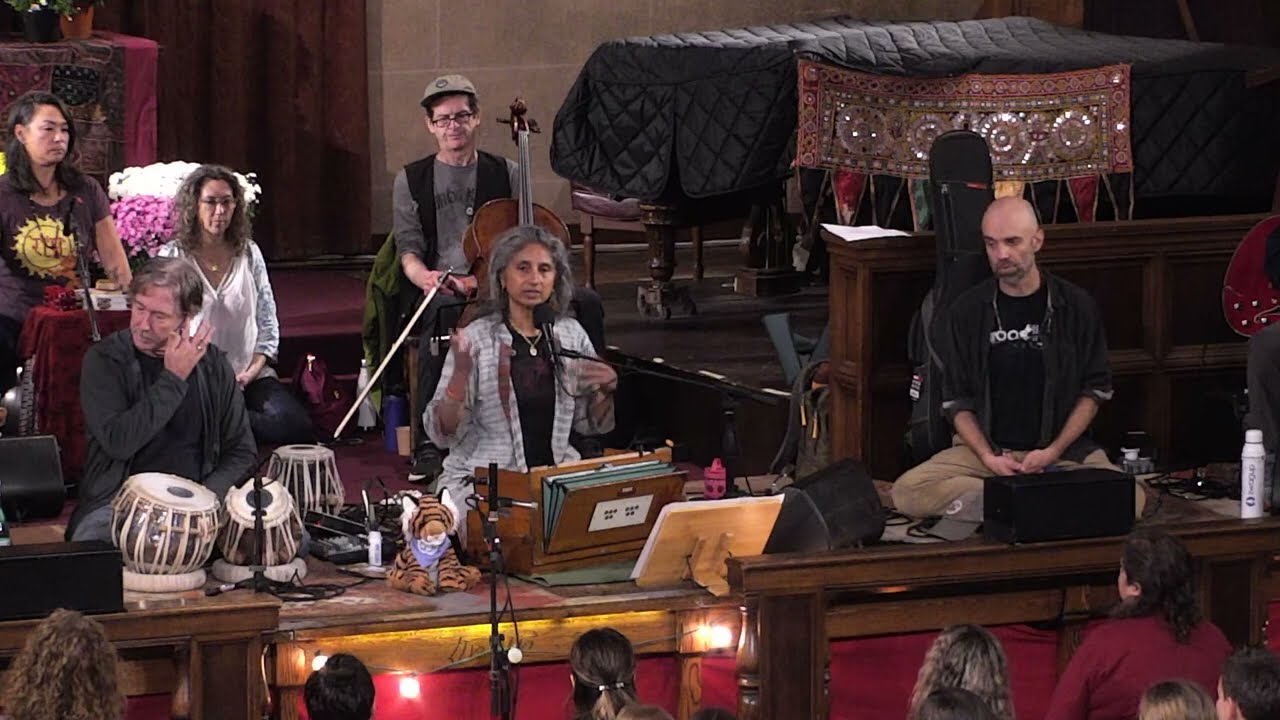
"Niagara," from Ram Dass Khalsa's EP The Unimaginable, is an original song-cycle that explores the architecture of spiritual release through the extended metaphor of Niagara Falls. The piece centers on a speaker grappling with personal loss—the death of a loved one ("baby")—and uses the churning, flowing, inevitable motion of water as both literal and archetypal language for how consciousness moves through grief toward surrender. Rather than resolving the pain, the song charts what it means to *walk through the pain* and entrust our burdens to something larger than the individual will. The work moves from protest ("arguing with God") through acceptance ("to the sea") to a hard-won recognition that spiritual practice means staying present with sorrow rather than transcending it.
What does the water metaphor reveal about spiritual surrender?
The central image of the song is Niagara Falls—a geological force, a boundary between states, and a threshold where land surrenders to water. Ram Dass Khalsa uses this site not as a tourist attraction but as a teaching apparatus. The falls "churn down below"; the speaker's life "overflows" and "slips out to sea." The water moves in only one direction: toward merger, dissolution, and return to vastness.
This metaphor does not sentimentalize release. The speaker does not volunteer for the journey. Instead, water becomes the unavoidable logic of existence itself. In Hindu and Buddhist cosmology, water represents the flow of time, change, and the dissolution of fixed identity. By invoking Niagara—a specific, thunderous, non-negotiable manifestation of that flow—the song anchors abstract spiritual principle in something witnessed, heard, felt. You can stand at Niagara and see surrender happening in real time.
The repeated invocation "won't you take all my troubles to the sea" is not a request for rescue but an act of offering. The speaker addresses Niagara as if it were a conscious agent, a devotional partner. This mirrors the language of bhakti (devotional) practice: naming the force larger than ourselves and asking it to carry what we cannot. The sea, in this context, becomes the ultimate container—the place where all separation dissolves and all individual sorrows become part of something unified and vast.
How does the song hold grief and faith in tension?
A striking line appears in the middle of the composition: "Niagara / You got me arguing with God / And I can't remember the last we talked." This is not a moment of peace. The speaker is quarreling with the divine—not in the sense of doubt, but in the sense of a profound disruption of relationship. Loss has created distance. The familiar conversation with the sacred has broken down.
This admission is crucial because it refuses the spiritual bypass common in devotional music: the idea that faith should eliminate anger or confusion. Instead, Ram Dass Khalsa acknowledges that grief can disrupt even long-standing spiritual practice. The arguing itself becomes honest—a form of fidelity to the truth of what is being experienced.
Yet the song does not leave the speaker in isolation. The refrain that follows—"trying to live here honestly"—suggests that the spiritual task is not to regain the lost peace, but to be truthful within the disruption. Honesty becomes the bridge between the broken conversation with God and the eventual surrender to the water. One does not transcend the grief; one walks through it.
What does "there's nothing to do but walk through the pain" teach about spiritual maturity?
The verse that rises out of the chorus contains what might be called the song's didactic center: "There's nothing to do but walk through the pain / Bending over backwards / Praying in the rain / An ocean of sorrows / And far too little time / I'm trying to save my family / But can I save mine?"
This passage strips away metaphor and descends into concrete human reality. There is no transcendence here—only the paradox of prayer and powerlessness, effort and impossibility. The speaker is "bending over backwards," exerting will, yet the outcome is not within reach. The line "can I save mine?" reflects a deeply honest question: if I am trying to preserve my family, my self, my loved ones, yet the forces of death and change are larger than my will, what then is the measure of spiritual practice?
The answer embedded in the song is not that prayer works as magic intervention, but that prayer becomes the way we *stay conscious* while walking through pain. "Praying in the rain" is not a prayer for the rain to stop; it is the conscious alignment with reality as it actually is. Spiritual maturity, in this teaching, means developing the capacity to remain present, aware, and open—even when nothing can be fixed or saved in the conventional sense.
The acknowledgment "an ocean of sorrows and far too little time" echoes the perennial Buddhist insight into dukkha (unsatisfactoriness): existence contains inherent suffering, finitude, and inadequacy. The spiritual path does not deny this reality but teaches us how to hold it without being destroyed by it. The "overflowing" and "slipping out to sea" become, in retrospect, not disasters but natural expressions of how consciousness must learn to surrender to what is.
How does the song use repetition as a spiritual practice?
The refrain "to the sea / to the sea / won't you take all my troubles to the sea" is repeated throughout the composition with slight variations. This is not mere rhetorical decoration. In mantra and kirtan practice (devotional singing traditions within Hinduism and related paths), repetition creates a groove, a rut in consciousness through which attention can flow toward the object of devotion. By repeating the phrase, the listener's nervous system is invited to sync with the rhythm and begin to *feel* the release, not just think about it.
The slight changes in wording—"overflowing," "slipping," "won't you take"—prevent the repetition from becoming mechanical. Each iteration deepens or shifts the relationship. The speaker's plea to Niagara becomes less a petitionary prayer and more a recognition that the surrender is already underway, whether the speaker consents or not. The water will continue to flow; the only question is whether consciousness remains present and open during that flow.
What is the relationship between the loss of "baby" and the larger spiritual teaching?
The opening lines—"You took my baby from me / And now he's flying home free"—establish the personal wound. This is not an abstraction. Someone close has died; the speaker experiences this as a taking, a theft, a wound. Yet immediately, a reframe appears: the one who is gone is "flying home free."
This is the central spiritual and psychological work of the song. The loss is real; the grief is valid. But simultaneously, the death can be viewed as a return, a liberation, a homecoming. Both truths coexist. The speaker does not move from grief to acceptance in a linear fashion but holds both simultaneously. The "baby" is taken and is free. The speaker is wounded and is learning to surrender.
In the language of Hindu advaita vedanta and related non-dual traditions, the individual soul (atman) is not separate from the larger reality (Brahman). From that perspective, what appears as loss in the realm of form is, from another viewpoint, a return to unity. Ram Dass Khalsa does not resolve this paradox but sings it, allowing the listener to inhabit the contradiction without needing to choose one truth over the other.
Where to go from here?
To engage with "Niagara" is to ask yourself: what am I currently defending or trying to control that might be ready to surrender? Where in your life is there resistance to the natural flow of change? The song is not a solution but an invitation to get honest about grief, to practice presence within pain, and to consider that the forces larger than our will—time, death, change, mystery—may not be enemies but teachers.
If this teaching resonates, explore other work by Ram Dass Khalsa and the broader sangha (community) of contemporary spiritual musicians who blend traditional wisdom with contemporary forms. Listen to the song multiple times, allowing the repetition to work not just on your mind but on your nervous system. Consider what personal losses you are still defending against, and experiment with the prayer: "won't you take my troubles to the sea?" Not as a request for rescue, but as a practice in releasing what you cannot carry.