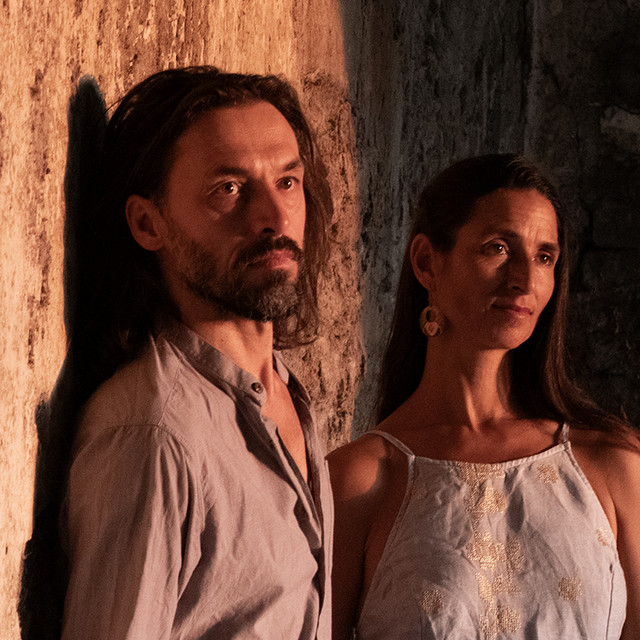
Mirabai Ceiba's official music video for "You Are A Song" presents a devotional exploration of how each being resonates as a living song within the cosmos. Through layered poetic imagery—song, flower, lover, secret place—the piece articulates the idea that individual consciousness participates in a continual divine expression, with the self understood not as separate from universal creative force but as an active channel for it. The composition weaves together voice, piano, guitar, violin, and synth to create a sonic representation of this non-dual understanding.
What Does It Mean That "You Are A Song"?
The central conceit of the piece operates on multiple levels. At its most immediate, the opening declaration—"you are a song, a song resonating in my soul"—establishes the listener not as an external object but as a dynamic presence already singing within the speaker's consciousness. This inverts conventional subject-object relations. Rather than the singer performing something external or separate, the song emerges from recognition of what already exists.
The phrase "a song that has been wished in long before a song has been sung in every place" suggests that this resonance predates individual awareness. The song exists across time and space, and the listener's particular incarnation is one expression of an ongoing universal song. This aligns with non-dual philosophy: the individual is not discovering something new but recognizing what has always been singing through all existence.
The musical structure reinforces this concept. Rather than a linear narrative arc, the composition cycles through related metaphors—song, flower, tree, lover, secret place—each one articulating the same fundamental recognition from a different angle. There is no climax of understanding; instead, there is deepening familiarity with the fact itself.
How Do the Metaphors of Flower and Living Presence Function?
The transition to "you are a flower, a little piece of life unfolding" marks a shift from abstract sound to embodied, organic existence. A flower does not ask whether it should bloom or defend its blossoming; it simply unfolds in response to sun and rain and light. The image captures a mode of being without resistance or self-consciousness.
Critically, the song specifies that this flower "dances about the sun and rain light" and "opens up in all the beings shine." The flower is not a closed, self-contained thing but a site of exchange—receiving light and moisture, offering fragrance and color. Likewise, the individual consciousness (addressed as "you") is positioned as permeable, participatory in larger ecological and spiritual flows.
The phrase "a flower blooming in my chest" indicates that the listener's presence is not something the speaker observes from outside but something literally growing within their own interior space. This suggests intimate non-separation: the other person's aliveness flowers within one's own body-heart. The recognition of another as a song, a flower, a living presence is inseparable from one's own deepest interiority.
What Role Does the Lover Archetype Play?
Later in the piece, the address shifts to "lover" and "secret place." These terms invoke both romantic and mystical intimacy. In the devotional traditions from which Mirabai Ceiba draws (particularly Bhakti and Sufi frameworks), the lover-beloved relationship serves as a metaphor for the soul's relationship with the divine. The lover here is not necessarily a romantic partner in the conventional sense but a presence that catalyzes surrender and recognition.
"You whisper longing into my skin; I dance with you and die" introduces the element of yearning and dissolution. The "death" referenced here is not literal death but the ego-death essential to devotional practice—the willingness to dissolve one's sense of separate identity into union with the beloved. "Longing" is not treated as lack or dissatisfaction but as the sacred ache that draws consciousness toward integration.
The metaphor of the "secret place where I take flight" frames the beloved as a threshold or sanctuary. Between two beings—in that relational space—ordinary rules dissolve. Dreams materialize; the face of the other becomes transparent to something infinite. This is not escapism but recognition that consciousness expands at the edge where self meets other.
How Does the Music Itself Embody These Concepts?
The composition by Markus Sieber and Angelika Baumbach creates a sonic environment that is both intimate and vast. Baumbach's voice carries the primary melodic material with precision and emotional nuance. Rather than belting or forcing intensity, the vocal delivery is vulnerable and direct—a whisper into the listener's ear as much as a proclamation.
The piano foundation provides harmonic and rhythmic stability while remaining open. The guitar and ronroco (a traditional Andean stringed instrument) add textural warmth and cultural grounding, referencing traditions in which Mirabai Ceiba's artistic practice is rooted. The violin by Bogdan Djukic weaves ascending and descending lines that mirror the organic, non-linear unfolding the lyrics describe. The synth and drums anchor the piece in contemporary production while maintaining the devotional atmosphere.
Rather than building toward a dramatic resolution, the arrangement sustains a state of presence. Musical phrases repeat and evolve but do not resolve into closure. This mirrors the core teaching: there is no final arrival, only continual recognition of what is already here. The song is an invitation to inhabit the space it creates rather than to witness a performed narrative.
What Is the Significance of "Always" in the Middle Section?
Embedded in the piece, the single word "always" appears to operate as an anchor point. Surrounded by musical passages and vocal ornaments, it punctuates the flow like a bell. In context, "always" may refer to the constancy of the song's resonance—that this presence is not intermittent or dependent on the listener's attention. The "you" that is a song, a flower, a lover, a secret place is always singing, always blooming, always calling.
This "always" also dissolves temporal progression. Rather than a before-and-after narrative (before I knew you / after I met you), the piece suggests an eternal present in which recognition occurs. The song names what has always been true and invites awareness of it now.
How Does the Video Composition Support the Sonic Content?
Directed by Irina and Anton (Happy Black Birds of Psydoc Film), the visual treatment complements rather than illustrates the lyrics. The video does not show a narrative sequence but creates an aesthetic space in which the song can breathe. Visual motifs—light, organic forms, intimate framing—echo the poetic imagery without literal translation.
This restraint is essential. Had the video over-literalized the song (showing an actual flower, an actual lover, etc.), it would narrow the field of recognition. Instead, the visual design remains suggestive, allowing each viewer to recognize themselves and the beloved in the space the music opens.
Where to Go From Here
If this piece resonates, deepening engagement could take several forms. Listen multiple times with attention to how each instrument enters and how the overall texture evolves. Notice where your attention goes—whether to the melody, the rhythmic pulse, the harmonic movement, or the emotional tone. Each point of entry is valid and may reveal different dimensions of meaning.
Explore other work by Mirabai Ceiba to understand how this piece fits within their broader artistic vision, which consistently integrates Eastern devotional traditions with contemporary musical language. Study the poetic and philosophical frameworks that inform this work—Bhakti philosophy, Sufi mysticism, non-dual Advaita Vedanta—to deepen comprehension of the metaphorical language.
Finally, consider how the song's central proposition applies to your own experience. If the person or presence most meaningful to you is a song already resonating in your soul, what shifts in how you relate to them? If you yourself are a song, a flower, a secret place where flight becomes possible, how might that recognition alter your sense of your own existence?


