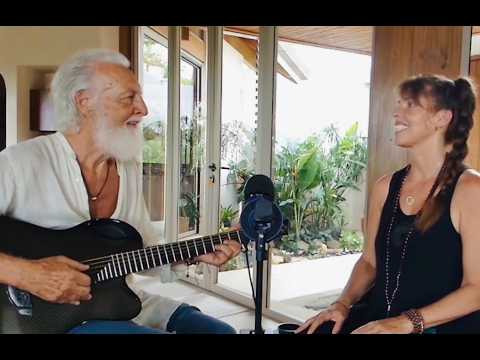
Chidananda is a Sanskrit mantra whose core affirmation—"I am eternal bliss, I am Shiva, I am consciousness"—points to non-dual awakening. The chant works through repetition of a simple, memorable phrase that anchors awareness in the Self. Performed live by Deva Premal and Miten with band at Zürich's Samsung Hall in September 2020, the piece exemplifies how kirtan (devotional singing) carries philosophical truth through melody, making abstract teachings accessible to the body and nervous system.
What Does "Chidananda" Mean?
Chidananda is a Sanskrit compound word that breaks into two roots: chit (consciousness) and ananda (bliss). Together, the term describes the state of consciousness-bliss—the recognition that your essential nature is not separate from pure awareness and unconditional joy. The mantra's full declaration—"Chidananda rupah shivoham shivoham"—translates as "I am eternal bliss; I am Shiva; I am consciousness." This is not aspirational language; it is a direct statement of non-dual truth common in Advaita Vedanta philosophy. Rather than suggesting "I will become bliss" or "I should cultivate bliss," the mantra affirms that bliss and consciousness are not distant states but your actual condition, prior to thought.
Shiva, invoked in the second clause, represents here not a deity external to you but the ultimate principle of pure consciousness and dissolution—the ground from which all form emerges and into which all form returns. By singing "I am Shiva," the practitioner is aligning the individual awareness with the universal, undivided reality. This is the heart of non-dual teaching: the apparent separation between self and cosmos is illusory, sustained only by conditioned thought patterns.
How Does Mantra Work in the Body?
Kirtan—devotional singing of Sanskrit mantras—operates on multiple levels simultaneously. On the cognitive level, the words carry meaning that the intellect can grapple with. On the sonic level, the melody and rhythm anchor attention and regulate the nervous system. On the subtle level, Sanskrit syllables are believed to carry vibrational frequencies that resonate with specific energy channels (nadis) in the body. When sung repeatedly, as in a live concert setting, the mantra does not merely communicate an idea; it creates a field of resonance that the listener's body absorbs directly.
In the Zürich performance, the live band—Manose on vocals and harmony, Joby Baker on bass, Spencer Cozens on piano, and Miles Bould on drums—constructs a musically sophisticated container for the mantra. The interplay between instruments and voice ensures that the chant does not become monotonous but instead evolves, maintains engagement, and deepens focus. Listeners report that sustained chanting of a single mantra produces a hypnagogic state, where the boundary between thinking and non-thinking softens, allowing direct recognition of consciousness itself.
Why Repeat a Single Phrase?
The economy of the Chidananda mantra—its brevity and rhythmic simplicity—is not a limitation but a strength. In contemplative practice, repetition of a short phrase bypasses the discursive mind. Where intellectual explanation generates more thoughts, which generate more thoughts, mantra repetition creates a narrowing of attention. The mind has fewer footholds for its habitual wandering; it must either follow the mantra or recognize the silence between repetitions. Over time, this practice reveals that "I am consciousness" is not a belief to adopt but a recognition available in the present moment, independent of whether you are thinking or not.
The three-fold assertion—"Chidananda rupah / shivoham / shivoham"—also employs a rhetorical structure common in Sanskrit teaching. By stating the truth three times, with slight variation, the mantra prevents mere intellectual agreement. Repetition allows the assertion to sink beneath the conceptual surface and touch the nervous system's own knowing. Practitioners often report that after sustained chanting, the words begin to feel self-evident rather than aspirational.
What Is Non-Dual Consciousness?
The philosophical framework underlying Chidananda draws from Advaita Vedanta, an ancient Indian school that posits a single, non-dual consciousness as the foundation of all existence. According to this view, the apparent multiplicity of the world—objects, bodies, minds, separate selves—are not illusions in the sense of being false, but rather appearances within consciousness, like waves in the ocean. The wave is made of water; it is not separate from the ocean. Similarly, your individual consciousness is not separate from the universal consciousness that pervades all existence.
The teaching is radical because it dissolves the ordinary sense of self as a bounded, vulnerable, mortal entity. If "I am Shiva"—if consciousness is your true nature—then the fears and desires that plague the ego-self are revealed as based on a fundamental misunderstanding. This is not about gaining something new but about dropping a false identification. The bliss (ananda) invoked in the mantra is not an emotional high but the natural peace that arises when you are no longer defending a separate self against an external world.
The Role of Live Performance in Spiritual Transmission
A live concert setting intensifies the power of kirtan. When hundreds of people in the Samsung Hall breathe together, sing together, and entrain their nervous systems to the same rhythm and melody, the boundaries between individual and collective temporarily dissolve. This shared state is not mystical fancy; neuroscience has documented that synchronized movement and vocalization reduce defensive activation in the brain and increase coherence in heart-rhythm variability. In other words, group kirtan creates a measurable physiological state of openness and integration.
The presence of skilled musicians, as in this Zürich performance, also matters. When Manose and the band maintain clear intonation, sensitive dynamics, and purposeful phrasing, the listeners' nervous systems can relax into the music rather than working to interpret poor sound. The production quality—documented in the credits to www.universalsounds.ch and Rann Audio in Bristol—ensures that the technical vessel does not distract from the medicine it carries.
How Can You Practice Chidananda?
The mantra is accessible whether you sing with a group or alone. Begin with the complete phrase: "Chidananda rupah shivoham shivoham." Listen to the recorded version on Spotify or the live performance to absorb the melody. Then, in your own practice space, sing the phrase repeatedly, allowing the words to synchronize with your breath. You need not achieve any particular state; the mantra itself guides the mind toward recognition. If thoughts arise—and they will—simply return attention to the words and melody without judgment.
Some practitioners find it helpful to sing the mantra aloud for a set period, then continue internally (in silence), and finally allow even the internal repetition to fade, resting in the silence. This arc mirrors the path the mantra points to: from gross (external speech) to subtle (internal speech) to causal (pure consciousness beyond speech). Each layer is valid; the "highest" state is not superiority but simplicity.
Where to Go From Here
If Chidananda resonates with you, explore the broader context of Advaita Vedanta philosophy through primary texts such as the Upanishads or commentaries by the teacher Nisargadatta Maharaj. Continue listening to the recorded performance, as repetition deepens integration. Consider attending live kirtan sessions in your area or connecting with Deva Premal and Miten's ongoing offerings through their newsletter and tour schedule. Most importantly, allow the mantra to work on you without demanding results. The recognition "I am consciousness" is not something you achieve but something you uncover—and it is always already present, waiting for your attention to turn inward and recognize its own nature.