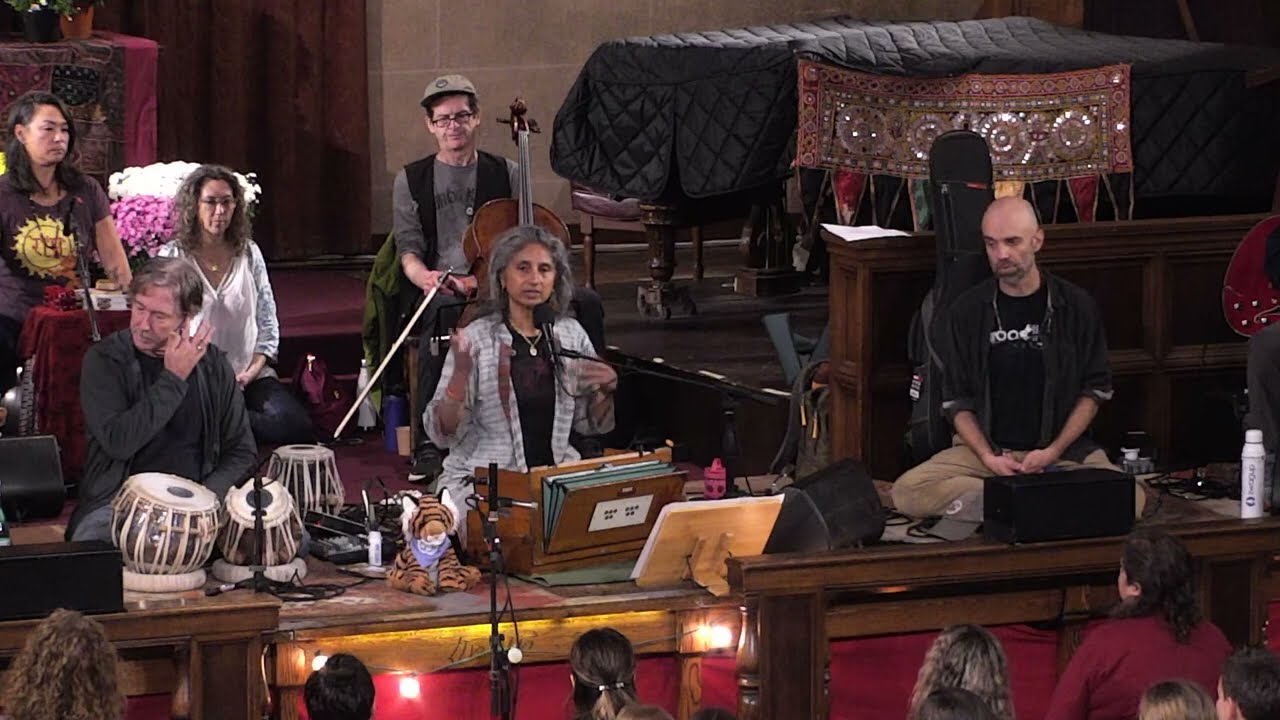
SIMRIT's "CCV" is a live kirtan performance that demonstrates how contemporary devotional music can bridge traditional spiritual practice with modern instrumentation—featuring vocals and harmonium by SIMRIT, alongside kora, cello, guitar, bass synthesizer, and percussion. The video showcases a full ensemble approach to kirtan, where each musician contributes distinct sonic textures to create an immersive devotional experience. This live performance represents an evolving lineage of kirtan in Western contexts, where practitioners adapt classical Indian devotional music for contemporary audiences while maintaining the practice's core intention of invoking spiritual presence and collective chanting.
What is Kirtan and How Does SIMRIT Reframe It for Modern Listeners?
Kirtan is a devotional singing practice rooted in Indian spiritual traditions, typically centered on repetitive chanting of sacred names, mantras, and divine qualities. The practice originated in Hindu and Sikh traditions as a method for invoking the divine through call-and-response chanting, where a lead vocalist guides a congregation through rhythmic, often ecstatic singing. SIMRIT's approach to kirtan, as demonstrated in the "CCV" performance, represents a contemporary interpretation of this ancient practice.
Rather than adhering strictly to traditional instrumentation—which typically centers on tabla (Indian drums) and sitar or sarod—SIMRIT's ensemble incorporates global and electronic instruments. The inclusion of cello, guitar, kora (a West African stringed instrument), and Moog synthesizer alongside the traditional harmonium reflects a deliberate aesthetic choice to make kirtan accessible and resonant for Western practitioners who may not have familiarity with Indian classical music forms. This approach does not dilute the practice; instead, it creates a bridge between devotional intention and sonic language that contemporary audiences recognize and respond to.
The harmonium, played by SIMRIT throughout the performance, remains the anchor instrument. The harmonium's portable nature and ability to sustain drone—a constant harmonic backdrop essential to kirtan—makes it indispensable. SIMRIT's vocals carry the melodic content and emotional weight, which is the heart of any kirtan practice. Her voice functions as both an instrument and a vessel for devotional energy, inviting listeners into the experience rather than performing at them.
How Do Multiple Instruments Create a Devotional Soundscape?
The ensemble composition in "CCV" reveals how kirtan can expand beyond minimalist arrangements. Salif Bamakora's kora provides rhythmic and harmonic complexity—the kora's plucked, harp-like quality adds an earthy, organic texture that complements the harmonium's drone. This combination of different percussion and melodic traditions creates what might be called a "global devotional language," where musical vocabulary from multiple cultures converges around a shared intention.
Shannon Hayden's cello and guitar contribute layered textures. The cello's bowed resonance can evoke emotional depth—a quality that Indian raga music prizes highly—while guitar provides harmonic grounding. Jared May's bass and Moog synthesizer anchor the bottom end, with the synthesizer potentially extending the drone texture into electronic territory. Devon Ashley's drums and percussion complete the rhythmic architecture, providing both steady pulse and dynamic variation.
This orchestration serves a specific function within kirtan practice: to create an environment where listeners feel held, supported, and invited into collective consciousness. Each instrument does not vie for attention but rather supports the central devotional act—SIMRIT's singing and the listener's internal resonance with the practice. The live video format captures this ensemble interplay, allowing viewers to see the musicians' physical presence and energetic commitment, which deepens the transmission beyond what an audio recording alone could convey.
What Role Does Intention Play in Kirtan Performance?
Kirtan is fundamentally a practice of intention. Unlike concert music, where technical virtuosity and emotional expression are primary goals, kirtan assumes that the act of singing sacred names or mantras carries inherent power. The musicians in SIMRIT's ensemble are not merely performing; they are facilitating a collective experience where intention—the focused acknowledgment of something sacred—becomes the connective tissue.
The presence of live sound engineering (handled by Matt Hagan according to the credits) and the professional production quality (mixing and mastering by Paul Mahan Kalpa Mahern) does not contradict this intention; rather, it honors it by ensuring that the devotional content reaches listeners with clarity and presence. When a viewer encounters this "CCV" video, the production quality allows them to feel the energy of the ensemble without distraction from technical limitations.
The lighting design (by Mark Jacoby) and cinematography (by Akhi Lavoie) further support this intention. Lighting in devotional contexts historically creates sacred space—a marked boundary between ordinary time and spiritual time. In a live video documentation, thoughtful lighting and camera work recreate that sense of entering a special container, a designated moment of practice.
Why Does Kirtan Use Repetition as a Spiritual Tool?
One fundamental principle of kirtan, implicit in any live devotional performance, is the use of repetition. By chanting the same phrases, names, or mantras repeatedly, practitioners engage in a form of cognitive and emotional attunement. Neuroscience research on mantra repetition suggests that rhythmic vocalization activates parasympathetic nervous system response, inducing states of calm and coherence. But more than physiology, repetition in kirtan functions as a doorway: the more one repeats a sacred sound or name, the more the mind settles into its meaning and vibration.
SIMRIT's "CCV" performance, structured as a live kirtan, would employ this principle throughout. The ensemble's repeated melodic phrases, supported by the steady pulse of drums and the continuous drone of the harmonium, create conditions for listeners' minds to synchronize with the collective energy. This is why kirtan practices often extend for 20 minutes, an hour, or longer—the extended repetition is not redundancy but deepening.
The video format paradoxically allows new listeners to experience kirtan without the time commitment of an in-person event, while also leaving open the possibility of rewatching or listening repeatedly, which itself becomes a form of practice.
How Does Kirtan Differ From Other Forms of Spiritual Music?
Kirtan distinguishes itself from genres like classical concert music, meditation music, or New Age ambient sound in several ways. Unlike bhajans (devotional songs that tell stories or describe the divine), kirtan typically centers on the repetition of a single name, phrase, or short mantra. Unlike Indian classical music, which showcases technical mastery and complex raga frameworks, kirtan prioritizes accessibility and collective participation over virtuosity for its own sake.
The "CCV" performance, viewed through this lens, is kirtan precisely because it invites listeners into a shared chanting experience rather than asking them to admire technical excellence or follow a complex narrative. The goal is not entertainment but attunement—a subtle shift in consciousness toward greater presence, peace, or devotion.
What Is the Role of the Musician as a Facilitator?
In kirtan, the lead vocalist and accompanying musicians function as facilitators rather than performers in the conventional sense. SIMRIT's role is to establish a safe, inviting container and to model the internal state that the practice aims to cultivate. By singing with devotion and presence, she communicates an implicit message: this practice is safe, this practice is valuable, this practice can touch something real within you.
The ensemble's collective commitment—evident in their synchronized playing and clear musical communication—reinforces this facilitatory function. Each musician's presence matters; together, they create a field that listeners can step into. This is consistent with traditional kirtan contexts, where a single singer with a drummer might gather a room full of people into unified chanting. The ensemble in "CCV" simply expands that field through additional sonic dimensions.
Where to Go From Here
For those encountering SIMRIT's "CCV" and wishing to deepen their engagement with kirtan, several pathways open. Seeking out live kirtan events in your community allows for the full-bodied experience of collective chanting—something a video cannot completely replicate, though it can inspire and prepare. Exploring SIMRIT's broader catalog on Spotify and her social media channels provides access to additional practices and performances. Following the musicians' individual work—whether Salif Bamakora's kora music, Shannon Hayden's cello explorations, or the ensemble's other collaborative projects—deepens understanding of how global musical traditions can serve devotional purposes.
Reading about the lineages of kirtan in the West, including figures like Krishna Das and Jai Uttal who pioneer similar fusion approaches, contextualizes SIMRIT's work within an evolving tradition. Ultimately, the invitation implicit in any kirtan video is to move from passive listening into active practice: to chant along, to feel the resonance in your own body, and to discover what becomes possible when voice and intention align.